3.8M
new manufacturing jobs the U.S. may need by 2033 — nearly half could go unfilled.
Deloitte & The Manufacturing Institute, 2024
~50% at risk of staying unfilled
HebronBee is an engine, built around a framework for capturing, digitizing, structuring and surfacing the tacit knowledge your team has already built — starting with guided interviews, and growing into the system your whole operation runs on.
Soter Analytics
Imagine replacing a technician with thirty years on this line. Even with the same machine and the same SOP followed exactly, the line won't run the way it used to — and nobody can say why. That instinct existed nowhere but in that one person.
Multiply that by an entire generation retiring at once. Factories that don't capture what their people carry won't just lose productivity.
They'll lose what made them competitive in the first place.
only near 50% may get filled
the U.S. needs by 2033 3.8M jobs
Deloitte & The Manufacturing Institute, 2024
3.8M
new manufacturing jobs the U.S. may need by 2033 — nearly half could go unfilled.
Deloitte & The Manufacturing Institute, 2024
~50% at risk of staying unfilled
$1T
potential cost to the U.S. economy from the manufacturing skills gap in 2030 alone.
Deloitte & The Manufacturing Institute, 2024
One year, U.S. economy-wide
14%
of Gen Z say they'd consider a career in manufacturing
Soter Analytics
86% not considering it at all
The next advantage in manufacturing won't only belong to whoever automates fastest
It will belong to whoever keeps their knowledge when their best people leave
We put together the full picture — sources, methodology, and what it means for your operation specifically.
Capture
Interview, guided scenario, mentor–apprentice pairing today — more added as the framework grows. Different knowledge comes out different ways, so HebronBee doesn't rely on one method alone
Below: capture in action, using the interview method.
Robert Chen · 34 yrs · Sr. Maintenance Tech
Line 4 bearing failures. I usually catch it before the sensors do.
What do you notice before the sensors pick it up?
Robert
There's a slight change in pitch. Higher than normal. The vibration sensor doesn't flag it until it's already gotten worse.
Have you seen this exact pattern before? What happened last time?
Robert
Yeah — 2016. We replaced the bearing but the mount was actually the problem. Bearing failed again in four months. Had to re-machine the mount.
What would you want a technician checking this for the first time to check, that isn't in the maintenance manual?
Structure
Not a raw transcript dumped into a folder. Each piece of knowledge is tagged to the equipment, the failure mode, the decision made, and what was tried before — so it's retrievable by someone who wasn't in the room.
KR-2026-0447 · captured 2026-01-14
Intuition
"There's a slight change in pitch. Higher than normal. The vibration sensor doesn't flag it until it's already gotten worse… Bearing failed again in four months. Had to re-machine the mount."
Surface
A technician on a 2am shift searches a symptom the way they'd describe it out loud, not the way it's labeled in a manual, and gets back what the organization has actually learned — including who's still around to ask.
"Has thisbefore?"
3 related records found
KR-2016-0089
Bearing replacement failed after 4 months — root cause was the mount, not the bearing.
Robert Chen · captured 2026-01-14 · retired contributor: no
KR-1997-0012
Near-identical pitch-change pattern, logged informally by a technician who retired in 2019.
Source: exit interview archive · never entered maintenance system
PEOPLE
Robert Chen and Dana Ibarra have both handled this failure mode. Dana is on shift now.
Cross-referenced from captured knowledge, not shift schedule
How it works
Input
Processing
Output
Why Bee
A bee doesn't withhold the physics of flight out of modesty. There's no version of "explain it" that exists — the knowledge was never encoded as words in the first place. It lives as motor pattern, not language.
Philosopher Michael Polanyi described the same limit in people: "We can know more than we can tell." He called it tacit knowledge — expertise that exists as pattern recognition, not as a retrievable set of rules. It isn't that your technician won't explain the sound a failing bearing makes. There often isn't a sentence to retrieve.
That's thirty years of experience, compressed below the level of words. We call the space between doing and telling the Just-Know Gap — and it's what HebronBee is built to work with, not around.
One bee discovers. The hive learns.
One technician solves. The company learns.
~230 Hz wingbeat
~Leading-edge vortex

No forward motion required to hover
A scout bee that finds a resource doesn't keep it to herself. She returns to the hive and communicates direction and distance through a waggle dance — so the whole colony can act on what one bee learned.
The same shape, a second job
The hexagon is the most efficient shape in nature — it holds the maximum amount of honey for the minimum amount of wax spent building it. Mathematically proven optimal by Thomas Hales in 1999.
The same shape does another job here: one captured record, holding as much context as possible, instead of the same knowledge rewritten in ten documents nobody keeps in sync.
Where it connects
HebronBee is not a replacement for your CMMS, MES or SCADA — it's the layer that explains the part of your operation those systems were never designed to capture.
How it gets used
onboarding
troubleshooting
capture
"We work with the generation that holds the mastery and the generation that will inherit it. HebronBee was born between those two worlds."

research
Original research on retirement exposure, tacit knowledge, time-to-competency and AI readiness in U.S. manufacturing.
editorial
An interview series with Liliya Valihun, recorded around ICC 2026 — what industry veterans know now that took a career to learn.
For those who pass it on, and those who'll receive it
What you know isn't written down anywhere yet — and it could be the foundation for the next generation. HebronBee doesn't ask you to become a curriculum designer or write a manual. Just tell it once, and that becomes material other people can actually use.
Your experience has value — and you can get paid for it.
While everyone worries AI is coming for their job, work with your hands is getting rarer and more valuable. This isn't the fallback if tech doesn't work out — it's an analog skill no algorithm can copy.
Working with your hands isn't old-fashioned anymore. It's the gold of the next 20 years.
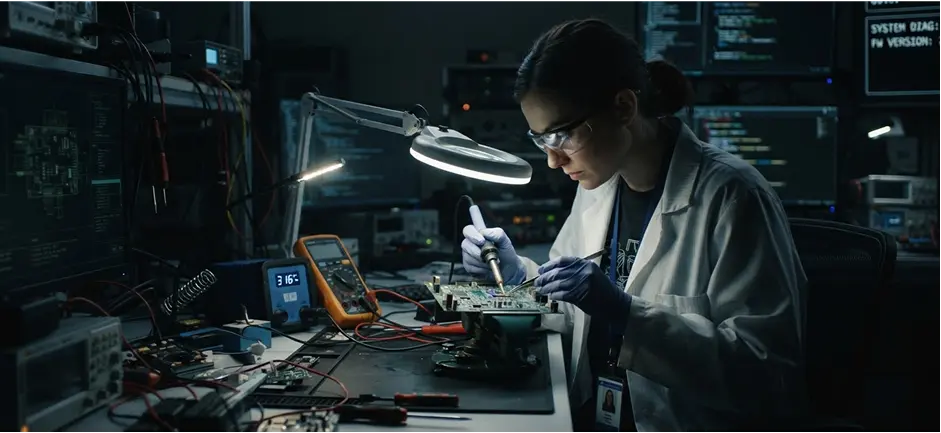
Who's building this
HebronSoft has been building software for manufacturing and industrial automation since 2017 — American company, engineering teams across Ukraine and Europe. HebronBee is developed inside the Innovation Lab, by the same team that ships production systems for manufacturing clients.


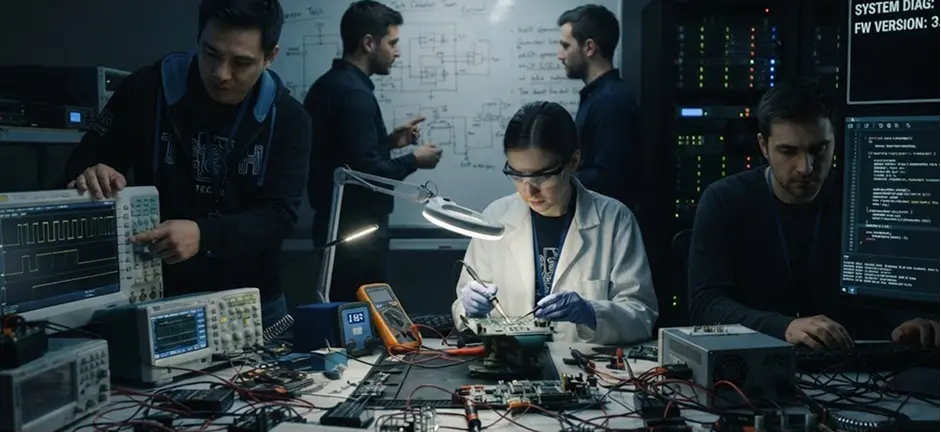
Early access is limited to a small group of manufacturers.